| 01 | THE PASSAGE |
| 02 | THE NOW |
| 03 | THE EXEMPLAR |
| 04 | THE NOTE |
| 05 | THE BOTTLE |
| 06 | THE FIND |
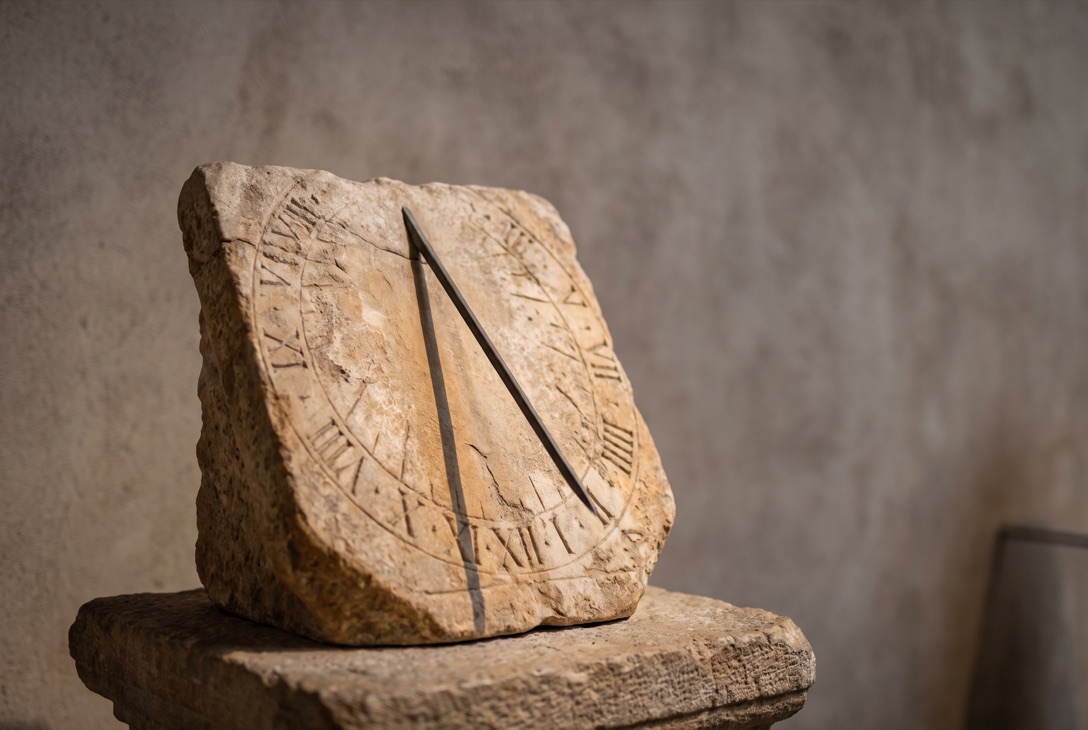
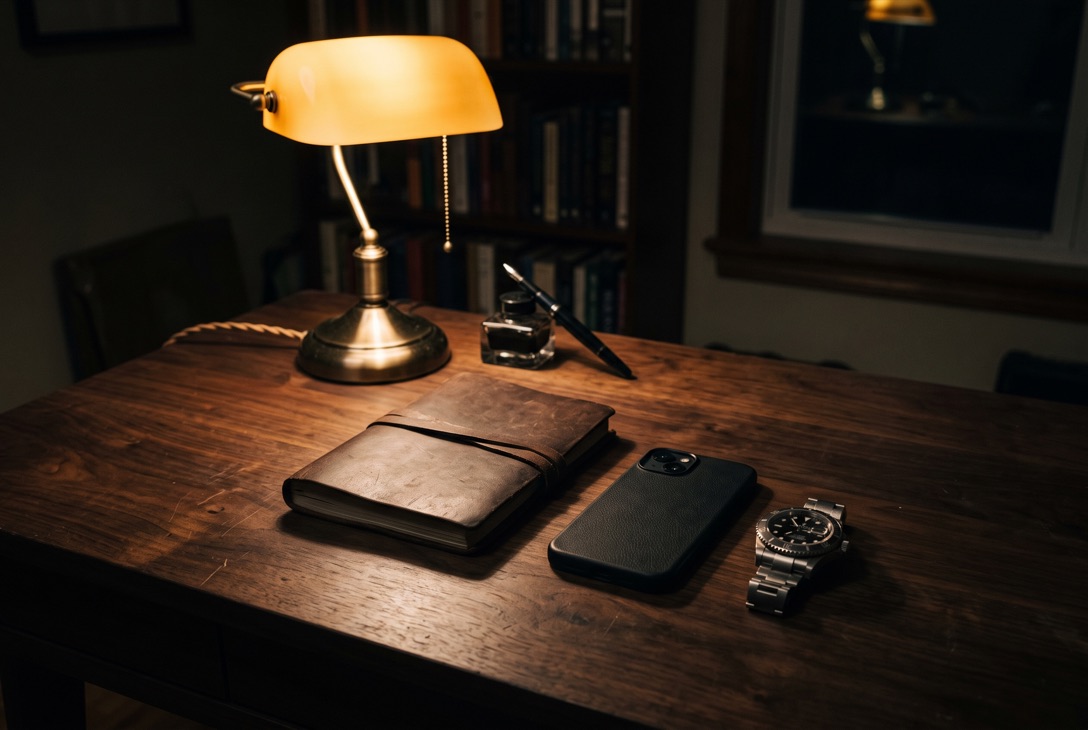
Put the phone face down on the desk for a moment and watch what happens to the hour around it. This is roughly the observation Augustine makes, in the middle of a very long book addressed to God, when he confesses that he does not know what time is; not as an admission of ignorance to be corrected two sentences later, but as the beginning of an argument he will not let go of for an entire book.
His reasoning proceeds, characteristically, by elimination. The past cannot be examined, since it has ceased to exist; the future cannot be examined, since it does not exist yet; and the present, examined closely enough, turns out to have no duration at all, vanishing into the past in the very act of being noticed. Say the word now, and by the time the word is finished the thing it named is already gone. It should not escape notice that this is not a complaint about being busy. It is a discovery about the object itself.
Where, then, does time live, if neither the past nor the future nor the present will hold still long enough to be examined? In the mind, Augustine answers, and nowhere else: time as we live it is a stretching of the mind across three directions at once, what he calls distentio animi, and the man rehearsing this morning's argument on his commute while drafting tonight's dinner conversation is not managing his time well or badly. He is being pulled apart by it, quietly, in three directions, and calling the sensation productivity.
Notice where this argument lands once it meets a phone. The feed is memory and anticipation, machine tooled and served back with a precision Augustine could not have imagined, by a system that has studied the reader's particular way of coming apart more closely than the reader has. He never met a recommendation engine, and he did not need to; he had already named its mechanism, sixteen centuries early, in an argument about attention scattered across three tenses belonging fully to none of them.
He also names the remedy, and gives it an old, unglamorous word: recollection. Not a mood a man falls into. A discipline practiced deliberately, gathering the scattered self back to the one place it has ever actually stood, which is here. No feed will teach this, for a reasonable reason: a mind gathered into the present is a mind no longer available to be sold.
The application, then, follows the argument rather than sitting beside it: one hour tonight, undistended. Choose one thing and be entirely inside it, the meal or the page or the man across the table, and each time the mind reaches back or forward, walk it home without ceremony. An hour given whole will outlast three spent leaking in every direction, and this is not a trick of the nerves; by Augustine's own account it is arithmetic. It is the only hour, out of all the hours spent today, that will actually have been owned.
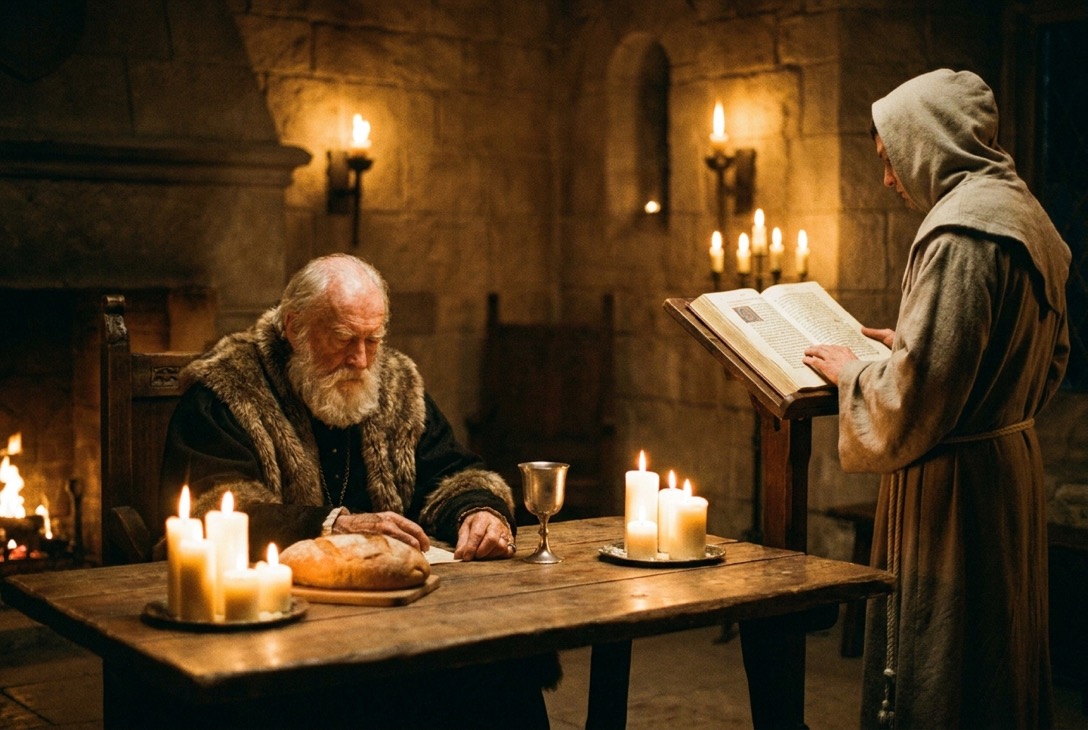
Charlemagne governed territory from the North Sea to Rome, campaigned for the better part of thirty years, and rebuilt the coinage, the courts, and the schools of half a continent more or less from scratch; and if any man in the eighth century had earned the right to eat his dinner in silence, too spent to think, it was he. He did not take it. At table, the most powerful man alive did not hold court and did not brood. He had a reader stand and read to him.
His biographer Einhard, who sat close enough to that table to know its habits exactly, records what filled the hour: histories, the deeds of the ancients, and, more than any other book, Augustine, above all the volumes called The City of God. Delectabatur, Einhard's word: he delighted in them. It would be easy to read this as decoration, an emperor performing seriousness for the record; it is worth noticing that Einhard reports it as habit rather than event, a thing done most nights rather than once for show, which is the detail that turns a pleasant anecdote into a genuine confession of what the man actually valued when no one outside that room could see him valuing it.
There is a second habit, recorded a chapter later, that is harder to read without something catching. Charlemagne kept wax tablets under his pillow, so that whenever an empty hour surfaced in the night, cum vacuum tempus esset, he could practice shaping letters with his own hand. He had come to writing late, too late, and Einhard does not soften the verdict: the effort, begun out of season, met with little success. Here is a hand that signed law for half of Europe, fumbling at its own alphabet in the dark, failing, and trying again the next empty hour regardless.
Notice where the unclaimed time went. Dinner, to Augustine; the sleepless margin, to an alphabet he would never fully own; nothing left lying in the road for whoever happened to want it first. He did not master writing, and that is not really the point. A man's empty hours are a confession of what he privately believes time is for, whether he says so aloud or not, and by that confession alone the busiest man of his age still stands taller than most of us, phone lit on the nightstand, giving our own unclaimed hours to whoever asks first.
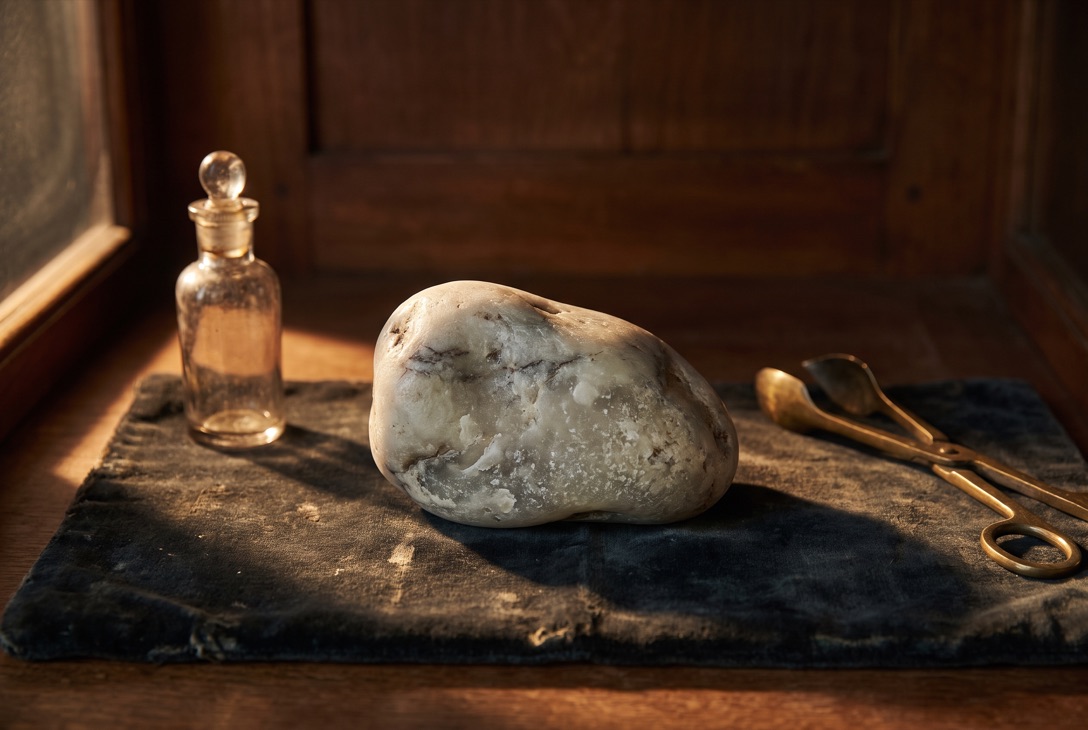
Every piece of ambergris begins as an accident inside the dark of a whale, and no one is present to witness what happens next; that absence of a witness is the whole story.
It hardens, most likely, around some fragment the animal could not digest, a squid's beak perhaps, and is in time expelled into open water, fresh and frankly disgusting, fecal and marine and wrong in every particular. Then it drifts, for years, sometimes decades, worked on by sun and salt with no one supervising and no clock running, and somewhere in that unwitnessed stretch it becomes another substance entirely: sweet where it was foul, animalic, nearer to old tobacco and warmed skin than to anything a whale ever produced. No one can look at the grey lump that washes ashore and say whether it spent two years at sea or twenty; it keeps its own counsel.
Sailors called the finest pieces floating gold and meant it literally; by weight, they have sold for more. Trading the real substance is now a federal crime in the United States under the Marine Mammal Protection Act, notwithstanding that no whale is harmed in its making, since it is waste, found rather than hunted; it remains legal across the United Kingdom and much of the European Union, a jurisdictional accident Augustine would have found entirely beside his point and entirely proving it.
Which brings the argument to 1946, when the Swiss chemist Leopold Ruzicka isolated the molecule behind ambergris's true character, and to 1950, when Firmenich, working from sclareol, an extract of ordinary clary sage, built a near identical compound and called it Ambroxan. What the industry could not do for another twenty seven years was prove the invention matched the thing it replaced; not until 1977 did anyone confirm the molecules lined up. Notice the shape of that gap: for nearly three decades an industry manufactured a memory of a smell it had not yet verified was accurate.
Here, entire, is Augustine's argument, sitting in a bottle on a shelf. The actual substance, expelled into a past no one witnessed, sits mostly beyond reach now; what nearly everyone smells in its place is a present trace, built to stand in for a thing none of us may touch directly. He would have known it at once.
Dior Sauvage, launched in 2015 and built by Francois Demachy, has become the best selling men's fragrance of the decade on the strength of a single wager: that Ambroxan, dosed far beyond any restraint a perfumer would ordinarily permit himself, could carry an entire composition alone.
Demachy did not disguise the wager so much as publish it. Dior's own launch materials use the word overdose, a rare admission for a house to make about one ingredient among many; cedar and labdanum sit somewhere beneath it, doing honest supporting work, but what the world actually recognizes, the clean, skin warm, faintly saline hum every men's fragrance since has had to reckon with, is Ambroxan and almost nothing else.
No one wearing it is wearing a whale, or anything a whale ever touched. They are wearing a molecule assembled in a Swiss laboratory, chasing a memory that laboratory had not yet confirmed was true.
Areej Le Dore is, to a first approximation, one perfumer working alone, known in the trade as Russian Adam, who has built a house out of materials most of the industry abandoned decades ago as too rare, too restricted, or too expensive to justify: real ambergris among them, real oud, animal tinctures nobody else will touch.
Atlantic Ambergris is built around an actual aged ambergris tincture and nothing pretending to be one. Each batch runs to something like a hundred bottles; when a run sells out, it is not remade. Scarcity here is not a marketing conceit. It is simply the truth of the material.
One fact worth knowing before going looking: trading real ambergris remains a federal crime in the United States, legal across the United Kingdom and much of the European Union, and the house ships from Indonesia, so import rules will vary by residence and are worth checking first. If Sauvage is ambergris as a molecule remembers it, this is as close as most of us will ever come to the thing a whale actually made.